10 Landlord Responsibilities You May Have Overlooked

rental agreement

If you own real estate and decide to lease it out to someone else, then congratulations: you are now a landlord in the eyes of the law. Whether you lease out a single family home or apartments in a multiplex building, there are many landlord responsibilities that come with the territory.

Some duties seem clear, like collecting rent or finding tenants for a vacant unit. Others, however, may be less obvious. The more you learn, the more success you will have with your real estate investments. Let’s examine 10 landlord responsibilities you may have overlooked.

1. Knowing the Landlord-Tenant Laws for Your Jurisdiction

Ignorance of the law is no excuse. It’s your responsibility as a landlord to know and understand all tenant-landlord regulations for your city and state. Landlords can be (and often are) sued for not obeying their state’s laws, even if they weren’t aware they existed.

2. Preparing a Legal Lease Document

The lease agreement and any other legal paperwork is all part of a landlord’s duties. It’s your responsibility to ensure the rental contract is legally written and abides by all laws. Leasing periods, monthly rental rates and tenant names must be clearly indicated. In some jurisdictions, legal disclosures, such as security deposit details, must be included. The lease should also contain all appropriate clauses, such as advising tenants to purchase renters’ insurance. Many states have required language that must be included, such as the Megan’s Law clause in California lease agreements.

3. The Duty to Deliver Possession

Once a lease contract is signed, it is the landlord’s responsibility to deliver possession of the rental unit to the tenant on the agreed-upon date. The unit must be in move-in condition and any previous tenants must have vacated the premises.

4. Implied Warranty of Habitability

Another obligation is to make sure the rental unit is in a safe, habitable condition. The property must not have any serious deficiencies, and any supplied appliances, fixtures, plumbing and heating must be in good working order. The property must be free of insects and pests. Landlords are generally responsible for getting infestations under control, even if they occur after tenants have moved in, although in most states landlords can avoid this by specifying in the rental agreement that pest control is the renter’s responsibility.

5. Respect the Tenant’s Right to Quiet Enjoyment

According to most landlord-tenant acts, tenants have the right to quiet enjoyment – meaning to have the benefit of living in their home without being disturbed. Once a tenant has possession of a property, the landlord may not interfere with this right. It’s therefore the landlord’s responsibility to ensure he or she does not enter the rental unit without proper notice (usually 24 – 48 hours, except in emergencies). When a landlord enters the rental property, it must be at a reasonable time of day and for a valid reason.

6. Completing Repairs in a Reasonable Time Frame

Tenants have the responsibility of reporting any repairs that need to be done. Landlords’ responsibilities include responding to these reports and completing repairs in a timely manner. Urgent repairs should be done right away, while minor issues can be addressed more conveniently. But beware that unrepaired damage tends to cause more damage, and tends to encourage tenants to vacate the rental property.

7. Providing Safety Measures

It is your duty to protect your tenants, to a point. In some jurisdictions, landlords must provide specific safety measures. These may include fire and carbon monoxide detectors, fire extinguishers, front door peepholes, deadbolt locks on exterior doors and window locks.

8. Reporting Crime

If a landlord becomes aware of any criminal activity taking place in one of their rental units, they must report it to authorities. For example, some landlord-tenant acts have specific laws that can find a landlord liable if their property is used for dealing or creating drugs.

9. On-Site Property Management

In some states, the law requires on-site property management of multiplex buildings of a certain size. In California, for example, landlords must provide on-site management of all residential rental buildings of 16 units or larger.

10. Responsible for Property Manager’s Acts

An often-overlooked concern is that you can be liable for your property manager’s acts, including illegal ones. If a property manager does not follow local landlord-tenant laws and a rental application is refused based on their religion or race, for example, the landlord can also be held responsible. Stay up-to-date on your rental property’s operations and keep a watchful eye on anyone who works for you.

Being a landlord involves a steep learning curve when starting out, and the laws aren’t always simple. Taking the time to learn about your responsibilities as a landlord can mean the difference between earning a nice profit and losing money – or worse. Protect yourself by learning the laws that apply to you and surrounding yourself with a team of professionals.

Do you know of any landlord responsibilities that many new landlords overlook? Which obligation surprised you when you first became a landlord? Share your comments below!

The Surging Real Estate Market Continues to Climb

The Surging Real Estate Market Continues to Climb

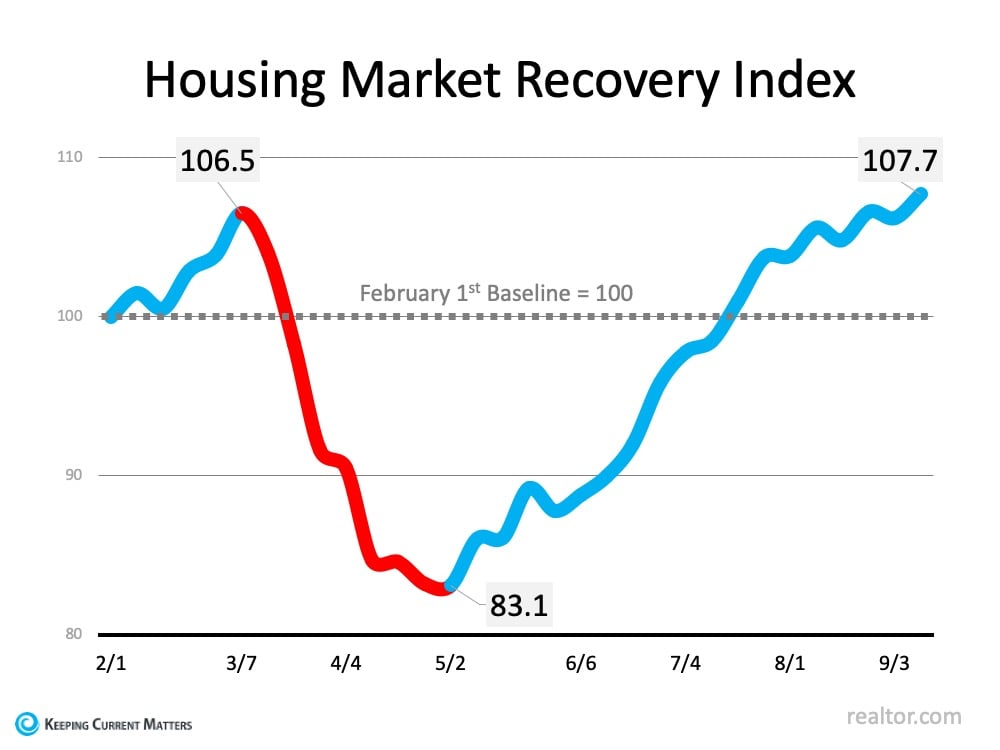
Earlier this year, realtor.com announced the release of the Housing Recovery Index, a weekly guide showing how the pandemic has impacted the residential real estate market. The index leverages a weighted average of four key components of the housing industry by tracking each of the following:

  1. Housing Demand – Growth in online search activity
  2. Home Price – Growth in asking prices
  3. Housing Supply – Growth of new listings
  4. Pace of Sales – Difference in time-on-market

The index compares the current status “to the January 2020 market trend, as a baseline for pre-COVID market growth. The overall index is set to 100 in this baseline period. The higher a market’s index value, the higher its recovery and vice versa.”

The Surging Real Estate Market Continues to Climb | Keeping Current Matters

The graph below charts the index by showing how the real estate market started out strong in early 2020, and then dropped dramatically at the beginning of March when the pandemic paused the economy. It also shows the strength of the recovery since the beginning of May.Today, the index stands at its highest point all year, including the time prior to the economic shutdown.

The Momentum Is Still Building

The Surging Real Estate Market Continues to Climb | Keeping Current Matters

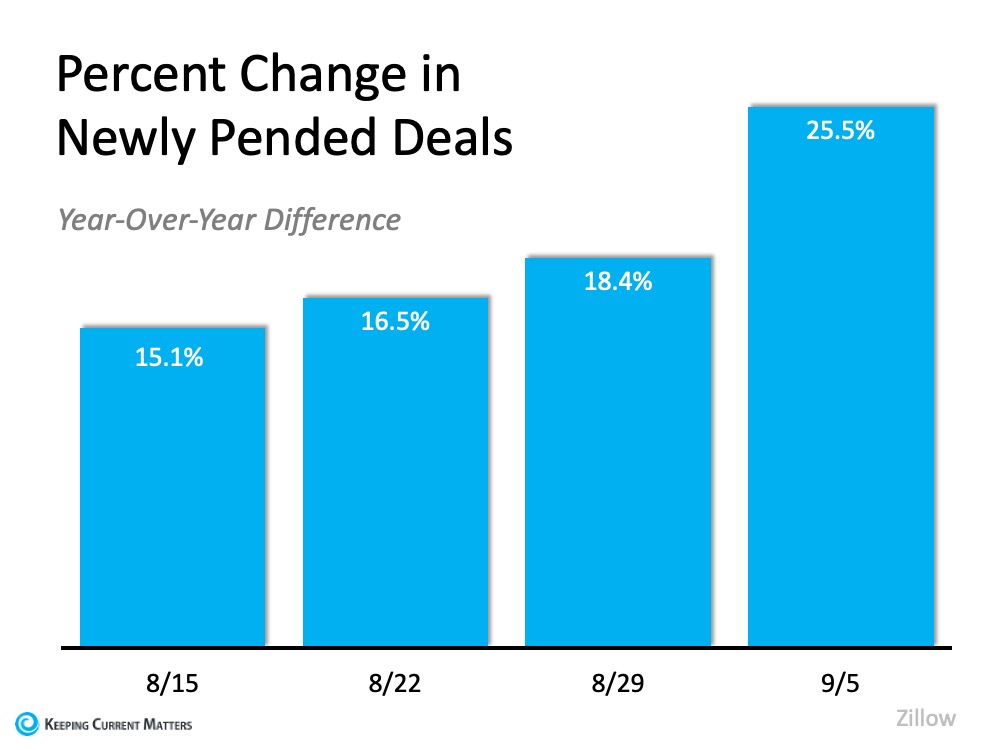
Though there is some evidence that the overall economic recovery may be slowing, the housing market is still gaining momentum. Zillow tracks the number of homes that are put into contract on a weekly basis. Their latest report confirms that buyer demand is continuing to dramatically outpace this same time last year, and the percent increase over last year is growing.Clearly, the housing market is not only outperforming the grim forecasts from earlier this year, but it is also eclipsing the actual success of last year.

Frank Martell, President and CEO of CoreLogicexplains it best:

“On an aggregated level, the housing economy remains rock solid despite the shock and awe of the pandemic.”

Bottom Line

Whether you’re considering buying or selling, staying on top of the real estate market over the coming months will be essential to your success.

V-Shaped Housing Market Recovery in July 2020

August 24, 2020By: Scholastica (Gay) Cororaton

Several indicators point to the quick recovery of the housing market from the pandemic slump during April and May, with home sales on an annualized rate in July now above the February level. Indicators gathered from a survey of REALTORS® that are reported in the August REALTORS® Confidence Index Survey also show that homebuying demand is strong, which means that the rebound in sales as a result from the end of shelter in place measures is likely to be sustained in the coming months.

Existing-home Sales Now Above Pre-pandemic Level

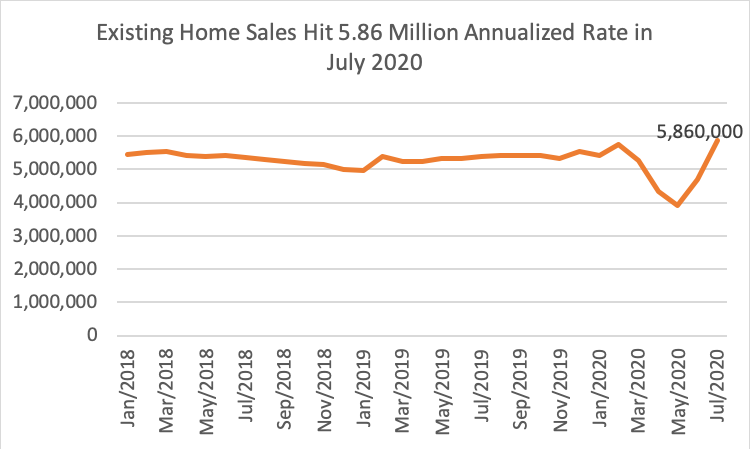
Existing-home sales rose a record 24.7% in July to an annualized rate of 5.86 million, which is higher than the pre-pandemic February level (5.76 million). On a year-to-date basis, existing-home sales (2.917 million) are just 5% below last year’s seven-month period level (3.062 million). The median existing-home sales price rose 8.5%, to $304,100, as demand strongly absorbed the supply coming into the market. As of the end of July, the level of inventory of homes for sale on the market was only equivalent to 3.1 months at 1.5 million homes, down 21.1% from one year ago.

Line graph: Annualized Rate of Existing-Home Sales January 2018 through July 2020

63% of Properties Typically Sold in a Month

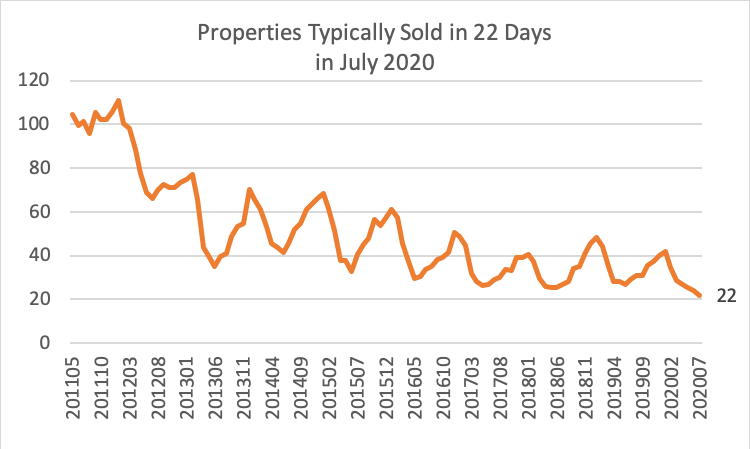
Properties were typically on the market for 22 days, a record low since NAR collected this survey-based information in 2011, according to the August REALTORS® Confidence Index Survey, a monthly survey of REALTORS® on their transactions during the month. One year ago, properties typically sold in 29 days. This is also faster than the median of 36 days in February prior to the coronavirus outbreak. Sixty-three percent of properties sold within one a month, compared to 51% one year ago and 47% in February.

Line graph: Median Days on Market May 2011 through July 2020

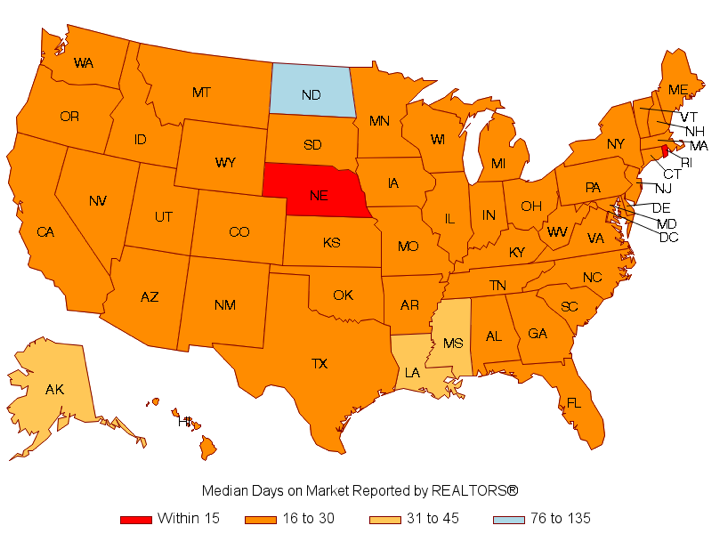
In almost all states, except for North Dakota, Alaska, Louisiana, and Mississippi, properties typically sold within one month. In Nebraska and Rhode Island, REALTORS® reported that properties typically sold in 15 days. Properties also sold quickly in states such as Idaho (17 days), Utah (18 days), Indiana (18 days), Tennessee (19 days), Washington (19 days), Massachusetts (19 days), Arizona (20 days), Colorado (20 days).

U.S. Map: Median Days on Market

Three Client Offers Per Property

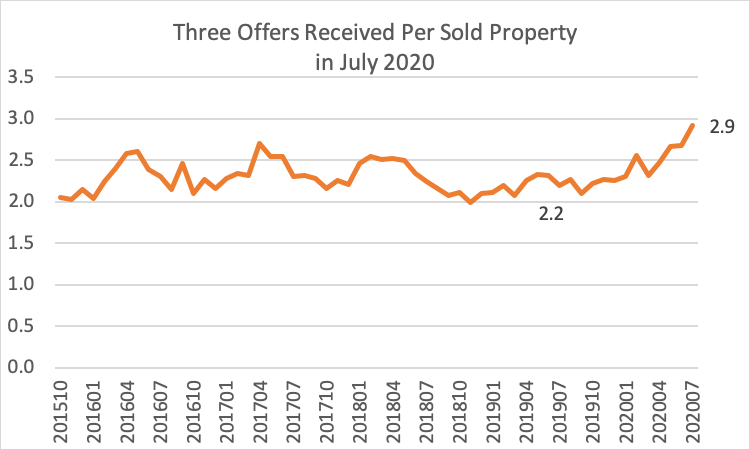
Not only are properties selling quickly, but they are also getting more offers. On average, REALTORS® reported nearly three offers per sold property in July 2020, up from about two offers one year ago.

Line graph: Number of Offers Received per Sold Property October 2015 through July 2020

Four Clients Taken on a Home Tour

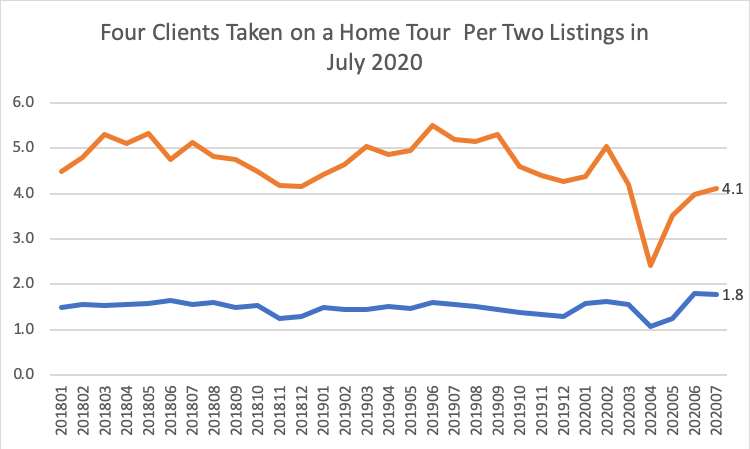
Demand has outpaced supply. On average, REALTORS® reported taking out four clients on a home tour, up from an average of two clients in February. Meanwhile, on average, REALTORS® reported listing only nearly two properties in July, although this is up from about one listing in April.

Line graph: Number of Clients Taken on a Home Tour per Listings January 2018 through July 2020

First-time Buyer Share Rose to 34%

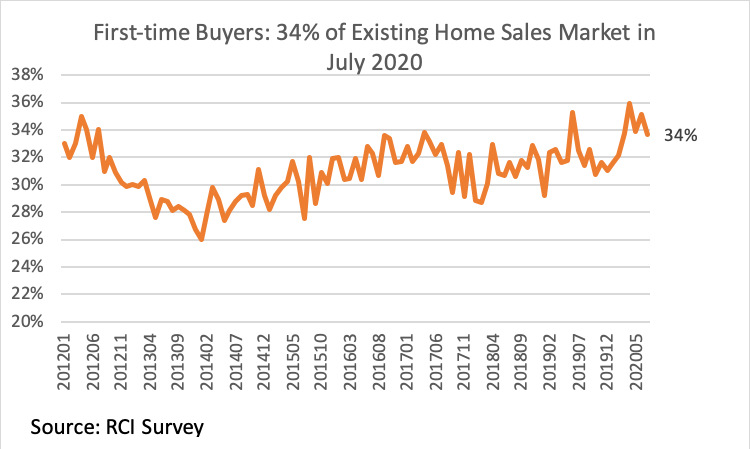
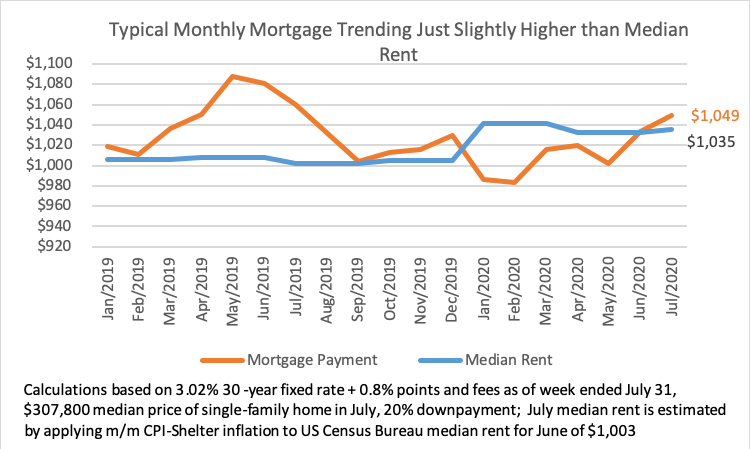
Who’s buying? In part, first-time homebuyers, which made up 34% of homebuyers in July 2020, up from 32% one year ago. Mortgage rates are at ultra-low levels, with the 30-year fixed rate averaging 3.02% in July 2020. The strong price appreciation has increased the monthly mortgage payment to $1,049 on a home purchased at the median sales price of $307,800 and financed with a 20% down payment loans, but this is just a little higher than the median rent of $1, 035. Concerns about safety and social distancing may also be increasing the demand for homes.

Line graph: First-Time Buyers Percent of Existing-Home Sales Market January 2012 through May 2020
Line graph: Typical Monthly Mortgage and Rent Costs January 2019 through July 2020

REALTORS® Buyer Traffic Index Shows Strong Demand

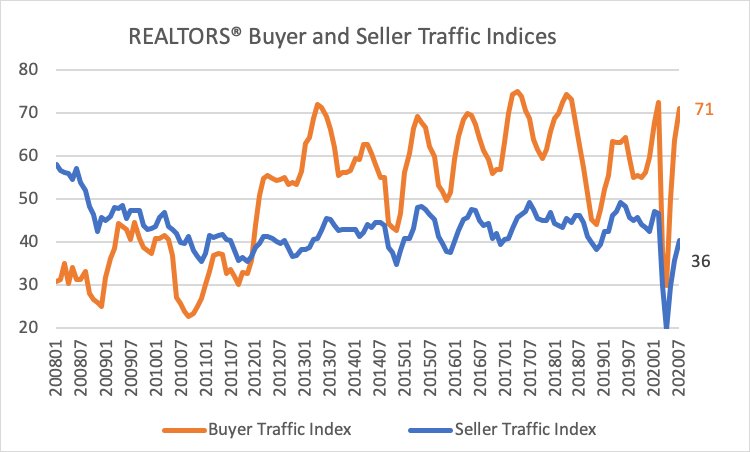
Compared to one year ago, about 4,000 REALTORS® reported that buyer traffic was broadly “strong.” The REALTORS® Buyer Traffic Index hit 71 in July, about the same level in February (72), after the index fell to below 50 in March and April.1 The housing market recovery has been relatively swift compared to the pace of recovery during the Great Recession when the Buyer Traffic Index stayed at below 50 from 2008 through 2011. Meanwhile, supply is broadly “weaker” compared to one year ago, with the REALTORS® Seller Traffic Index trending below 50.

Line graph: REALTORS® Buyer and Seller Traffic Indices January 2008 through July 2020

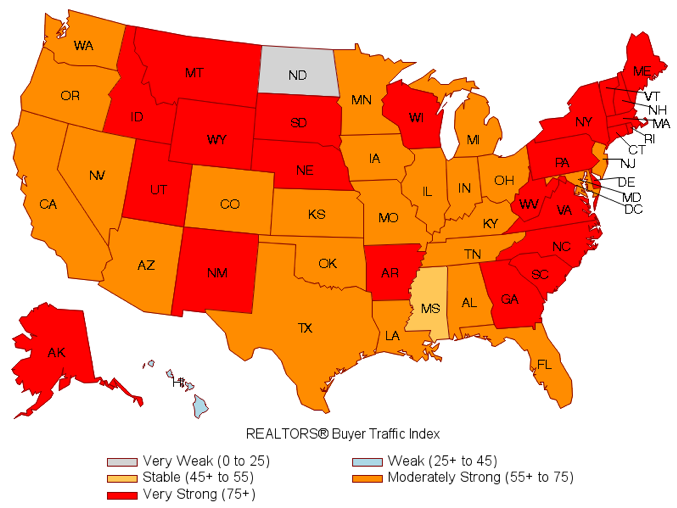
Respondents from all states reported that market conditions were broadly stable or strong, except in North Dakota which continues to be impacted by the drop in crude oil prices.

U.S. Map: REALTORS® Buyer Traffic Indices

1 The index measures homebuying activity in the reference month (July) compared to one year ago. An index above 50 more respondents reported that home searching activity rose compared to one year ago than the number of respondents who reported a decline.

4 Reasons Why Now Is The Ideal Time To Sell Your Southern California Home

by First Team Real Estate | Jun 30, 2020 | Buying | 0 comments4 Reasons Why Now Is The Ideal Time To Sell Your Southern California Home

Wondering when the ideal time to sell your Southern California home is? The answer could be right now. We always want to help you make the smartest decisions when it comes to your real estate investments, and that’s why it’s important to know that right now is the absolutely ideal time to sell your home because of our current seller’s market. Inventory is low, prices are rising, and pent-up demand alongside low mortgage rates has the market flooded with homebuyers.

Low housing inventory

This April, inventory fell to its lowest level ever recorded for the month across the country according to the National Association of Realtors®. A seller’s market in real estate is defined by 3 months of inventory or less, and inventory across Southern California just reached 3 months. This limited supply keeps prices high as buyers compete to get a deal. Pending and sold transactions have just begun rising so the sooner you list this summer, the less competition there will be for you, equating to a very high probability of getting multiple, quality offers on your home.

Prices have continued to rise

Across the board, U.S. home prices have continued to rise despite coronavirus, gaining 5.5% in April according to NAR data. The major bottleneck in inventory, and a tremendous amount of buyer interest, is supporting this price growth. Speaking of which…

Image of California coastline dotted with homes for sale. Text over images reads "4 Reasons Why It's The Ideal Time to Sell Your SoCal Home"

Buyer demand is off the charts

At the beginning of June, home-buying activity rose to about 88.9% of where it was before lockdowns disrupted the market according to data from realtor.com. This is thanks in part to historically low mortgage rates that have fallen as low as 3.13%. This was also pent-up demand from an unusually slow spring, rebounding along with the real estate market now that our country begins to open back up.

Low mortgage rates

According to our Weekly Mortgage Watch, rates have hit historic lows and they’re projected to remain low amid Coronavirus. This creates a huge incentive for buyers who are ready to purchase and jumping into the market today. And as a homeowner, this influx of eager buyers (and multiple offers) creates an opportune time to sell as well. If you’re ready to sell your house, know that the motivation for buyers to purchase right now is as high as ever with rates where they are today.

Low mortgage rates also ensure you can sell your home and get an amazingly low rate on your dream home, making it more affordable now than ever.

Obviously everyone’s individual situation is unique, but for the majority of homeowners, this marks a particularly advantageous opportunity to cash out big when you sell your home and secure a low mortgage rate for yourself to buy your dream home. If you’re unsure, click here to check your home’s current value.

ORANGE COUNTY MARKET TRENDS 5/23/2020

Limited Inventory, Demand continues gaining momentum, Interest rates at a History Low, Plus incentives such as down-payment assistance programs for buyer are offering great opportunities to those looking to buy and sell! . . .
If you are paying more than $2,500 in rent, you can afford a mortgage. Send me a message and let’s have a conversation on how to take advantage of the opportunities now available…

by Marlon Gamez REALTOR®  |  Lic# 0‌2076704 (714) 650-0567 marlongamez@firstteam.com marlongamez.firstteam.com