10 Landlord Responsibilities You May Have Overlooked

rental agreement

If you own real estate and decide to lease it out to someone else, then congratulations: you are now a landlord in the eyes of the law. Whether you lease out a single family home or apartments in a multiplex building, there are many landlord responsibilities that come with the territory.

Some duties seem clear, like collecting rent or finding tenants for a vacant unit. Others, however, may be less obvious. The more you learn, the more success you will have with your real estate investments. Let’s examine 10 landlord responsibilities you may have overlooked.

1. Knowing the Landlord-Tenant Laws for Your Jurisdiction

Ignorance of the law is no excuse. It’s your responsibility as a landlord to know and understand all tenant-landlord regulations for your city and state. Landlords can be (and often are) sued for not obeying their state’s laws, even if they weren’t aware they existed.

2. Preparing a Legal Lease Document

The lease agreement and any other legal paperwork is all part of a landlord’s duties. It’s your responsibility to ensure the rental contract is legally written and abides by all laws. Leasing periods, monthly rental rates and tenant names must be clearly indicated. In some jurisdictions, legal disclosures, such as security deposit details, must be included. The lease should also contain all appropriate clauses, such as advising tenants to purchase renters’ insurance. Many states have required language that must be included, such as the Megan’s Law clause in California lease agreements.

3. The Duty to Deliver Possession

Once a lease contract is signed, it is the landlord’s responsibility to deliver possession of the rental unit to the tenant on the agreed-upon date. The unit must be in move-in condition and any previous tenants must have vacated the premises.

4. Implied Warranty of Habitability

Another obligation is to make sure the rental unit is in a safe, habitable condition. The property must not have any serious deficiencies, and any supplied appliances, fixtures, plumbing and heating must be in good working order. The property must be free of insects and pests. Landlords are generally responsible for getting infestations under control, even if they occur after tenants have moved in, although in most states landlords can avoid this by specifying in the rental agreement that pest control is the renter’s responsibility.

5. Respect the Tenant’s Right to Quiet Enjoyment

According to most landlord-tenant acts, tenants have the right to quiet enjoyment – meaning to have the benefit of living in their home without being disturbed. Once a tenant has possession of a property, the landlord may not interfere with this right. It’s therefore the landlord’s responsibility to ensure he or she does not enter the rental unit without proper notice (usually 24 – 48 hours, except in emergencies). When a landlord enters the rental property, it must be at a reasonable time of day and for a valid reason.

6. Completing Repairs in a Reasonable Time Frame

Tenants have the responsibility of reporting any repairs that need to be done. Landlords’ responsibilities include responding to these reports and completing repairs in a timely manner. Urgent repairs should be done right away, while minor issues can be addressed more conveniently. But beware that unrepaired damage tends to cause more damage, and tends to encourage tenants to vacate the rental property.

7. Providing Safety Measures

It is your duty to protect your tenants, to a point. In some jurisdictions, landlords must provide specific safety measures. These may include fire and carbon monoxide detectors, fire extinguishers, front door peepholes, deadbolt locks on exterior doors and window locks.

8. Reporting Crime

If a landlord becomes aware of any criminal activity taking place in one of their rental units, they must report it to authorities. For example, some landlord-tenant acts have specific laws that can find a landlord liable if their property is used for dealing or creating drugs.

9. On-Site Property Management

In some states, the law requires on-site property management of multiplex buildings of a certain size. In California, for example, landlords must provide on-site management of all residential rental buildings of 16 units or larger.

10. Responsible for Property Manager’s Acts

An often-overlooked concern is that you can be liable for your property manager’s acts, including illegal ones. If a property manager does not follow local landlord-tenant laws and a rental application is refused based on their religion or race, for example, the landlord can also be held responsible. Stay up-to-date on your rental property’s operations and keep a watchful eye on anyone who works for you.

Being a landlord involves a steep learning curve when starting out, and the laws aren’t always simple. Taking the time to learn about your responsibilities as a landlord can mean the difference between earning a nice profit and losing money – or worse. Protect yourself by learning the laws that apply to you and surrounding yourself with a team of professionals.

Do you know of any landlord responsibilities that many new landlords overlook? Which obligation surprised you when you first became a landlord? Share your comments below!

The Surging Real Estate Market Continues to Climb

The Surging Real Estate Market Continues to Climb

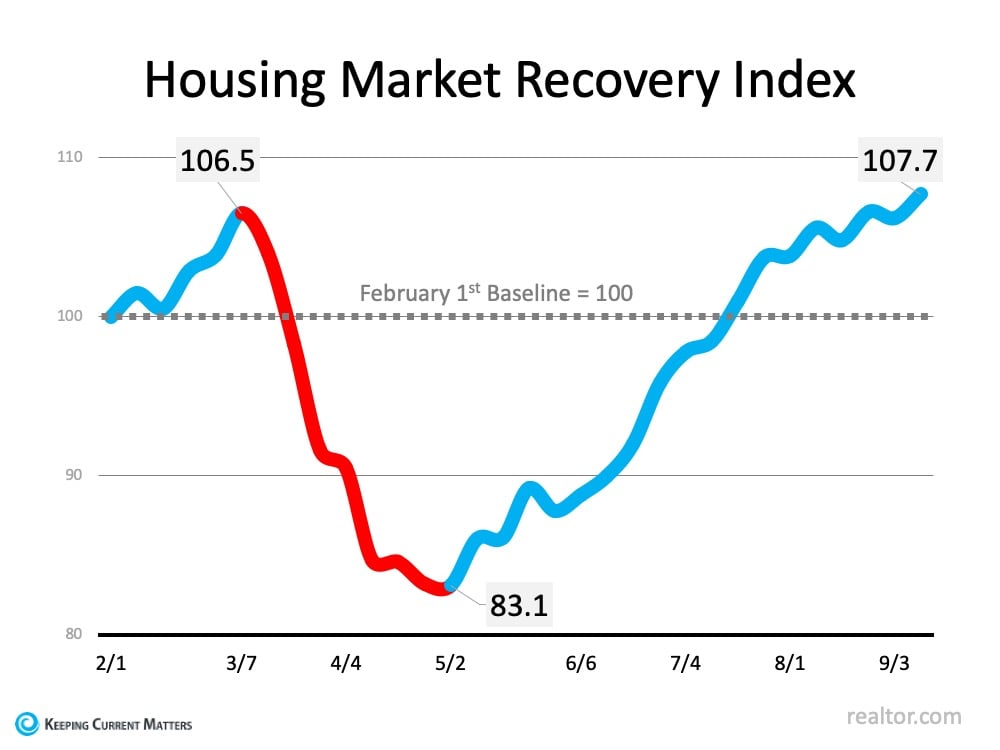
Earlier this year, realtor.com announced the release of the Housing Recovery Index, a weekly guide showing how the pandemic has impacted the residential real estate market. The index leverages a weighted average of four key components of the housing industry by tracking each of the following:

  1. Housing Demand – Growth in online search activity
  2. Home Price – Growth in asking prices
  3. Housing Supply – Growth of new listings
  4. Pace of Sales – Difference in time-on-market

The index compares the current status “to the January 2020 market trend, as a baseline for pre-COVID market growth. The overall index is set to 100 in this baseline period. The higher a market’s index value, the higher its recovery and vice versa.”

The Surging Real Estate Market Continues to Climb | Keeping Current Matters

The graph below charts the index by showing how the real estate market started out strong in early 2020, and then dropped dramatically at the beginning of March when the pandemic paused the economy. It also shows the strength of the recovery since the beginning of May.Today, the index stands at its highest point all year, including the time prior to the economic shutdown.

The Momentum Is Still Building

The Surging Real Estate Market Continues to Climb | Keeping Current Matters

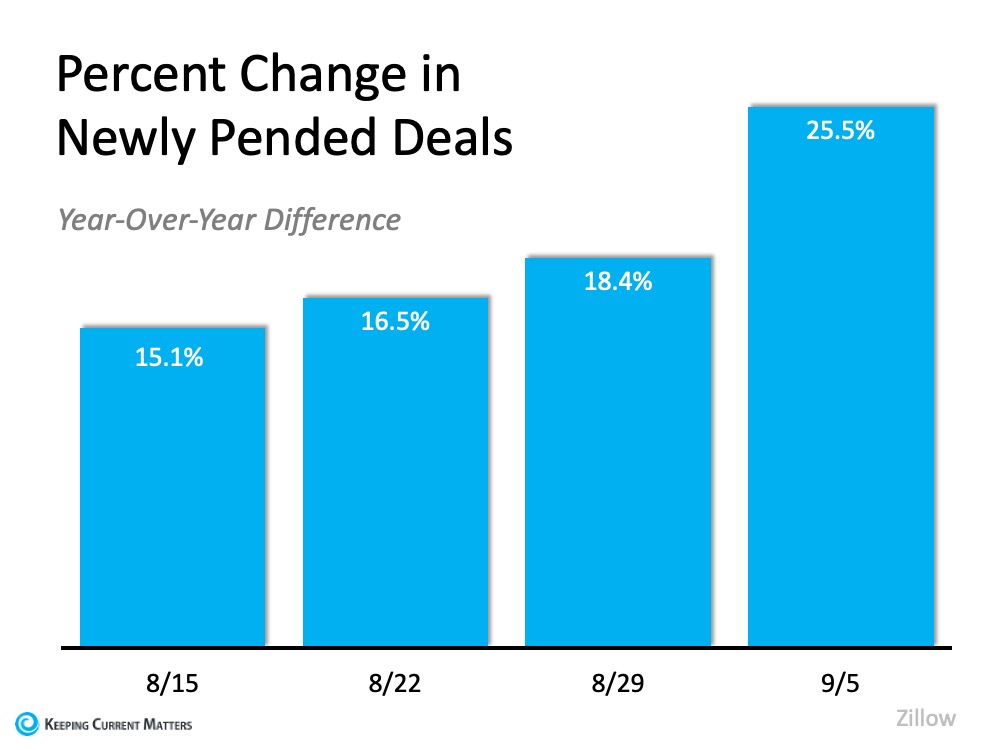
Though there is some evidence that the overall economic recovery may be slowing, the housing market is still gaining momentum. Zillow tracks the number of homes that are put into contract on a weekly basis. Their latest report confirms that buyer demand is continuing to dramatically outpace this same time last year, and the percent increase over last year is growing.Clearly, the housing market is not only outperforming the grim forecasts from earlier this year, but it is also eclipsing the actual success of last year.

Frank Martell, President and CEO of CoreLogicexplains it best:

“On an aggregated level, the housing economy remains rock solid despite the shock and awe of the pandemic.”

Bottom Line

Whether you’re considering buying or selling, staying on top of the real estate market over the coming months will be essential to your success.

Why Is It so Important to Be Pre-Approved in the Homebuying Process?

Why Is It so Important to Be Pre-Approved in the Homebuying Process?

You may have heard that pre-approval is a great first step in the homebuying process. But why is it so important? When looking for a home, the temptation to fall in love with a house that’s outside your budget is very real. So, before you start shopping around, it’s helpful to know your price range, what you’re comfortable within a monthly mortgage payment, and ultimately how much money you can borrow for your loan. Pre-approval from a lender is the only way to do this.

According to a recent survey from realtor.com, many buyers are making the mistake of skipping the pre-approval step in the homebuying process:

“Of over 2,000 active home shoppers who plan to purchase a home in the next 12 months, only 52% obtained a pre-approval letter before beginning their home search, which means nearly half of home buyers are missing this crucial piece of paperwork.

This paperwork (the pre-approval letter) shows sellers you’re a qualified buyer, something that can really help you stand out from the crowd in the current ultra-competitive market.

How competitive is today’s market? Extremely – especially among buyers.

With limited inventory, there are many more buyers than sellers right now, and that’s fueling the competition. According to the National Association of Realtors (NAR), homes are receiving an average of 2.9 offers for sellers to negotiate, so bidding wars are heating up.

Pre-approval shows homeowners you’re a serious buyer. It helps you stand out from the crowd if you get into a multiple-offer scenario, and these days, it’s likely. When a seller knows you’re qualified to buy the home, you’re in a better position to potentially win the bidding war and land the home of your dreams.

Danielle Hale, Chief Economist for realtor.com notes:

“For ‘a buyer in a competitive market, it’s typically essential to have pre-approval done in order to submit an offer, so getting it done before you even look at homes is a smart move that will enable a buyer to move fast to put an offer in on the right home.’”

In addition, today’s housing market is also changing from moment to moment. Interest rates are low, prices are going up, and lending institutions are regularly updating their standards. You’re going to need guidance to navigate these waters, so it’s important to have a team of professionals (a loan officer and a real estate agent) making sure you take the right steps along the way and can show your qualifications as a buyer at the time you find a home to purchase.

Bottom Line

In a competitive market with low inventory, a pre-approval letter is a game-changing piece of the homebuying process. If you’re ready to buy this year, reach out to a local real estate professional (who can also connect you with a trusted lender) before you start searching for a home.

V-Shaped Housing Market Recovery in July 2020

August 24, 2020By: Scholastica (Gay) Cororaton

Several indicators point to the quick recovery of the housing market from the pandemic slump during April and May, with home sales on an annualized rate in July now above the February level. Indicators gathered from a survey of REALTORS® that are reported in the August REALTORS® Confidence Index Survey also show that homebuying demand is strong, which means that the rebound in sales as a result from the end of shelter in place measures is likely to be sustained in the coming months.

Existing-home Sales Now Above Pre-pandemic Level

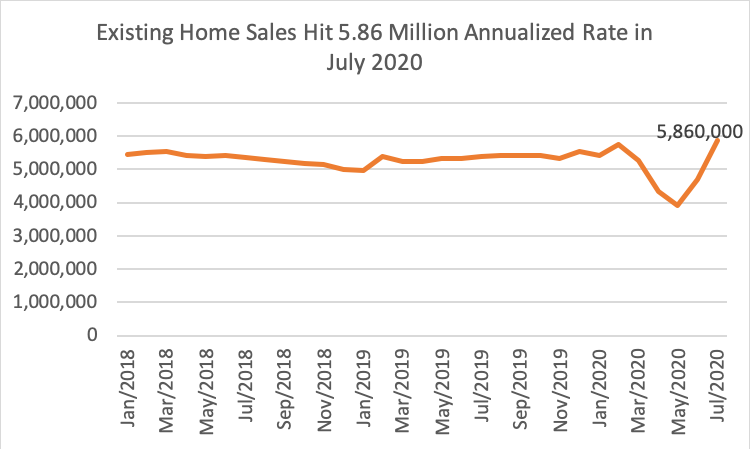
Existing-home sales rose a record 24.7% in July to an annualized rate of 5.86 million, which is higher than the pre-pandemic February level (5.76 million). On a year-to-date basis, existing-home sales (2.917 million) are just 5% below last year’s seven-month period level (3.062 million). The median existing-home sales price rose 8.5%, to $304,100, as demand strongly absorbed the supply coming into the market. As of the end of July, the level of inventory of homes for sale on the market was only equivalent to 3.1 months at 1.5 million homes, down 21.1% from one year ago.

Line graph: Annualized Rate of Existing-Home Sales January 2018 through July 2020

63% of Properties Typically Sold in a Month

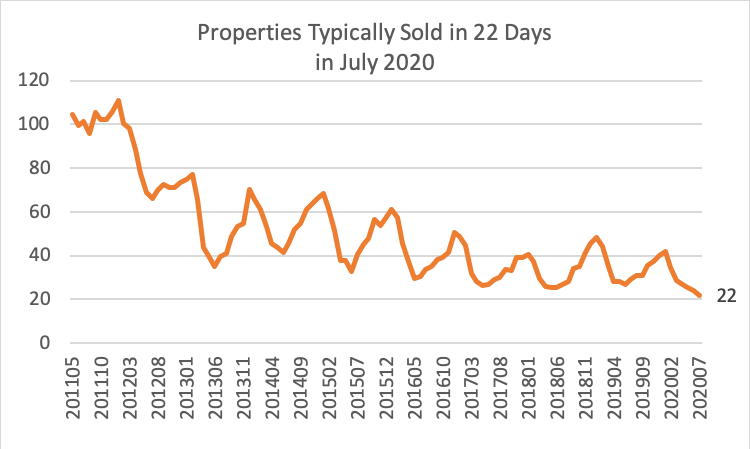
Properties were typically on the market for 22 days, a record low since NAR collected this survey-based information in 2011, according to the August REALTORS® Confidence Index Survey, a monthly survey of REALTORS® on their transactions during the month. One year ago, properties typically sold in 29 days. This is also faster than the median of 36 days in February prior to the coronavirus outbreak. Sixty-three percent of properties sold within one a month, compared to 51% one year ago and 47% in February.

Line graph: Median Days on Market May 2011 through July 2020

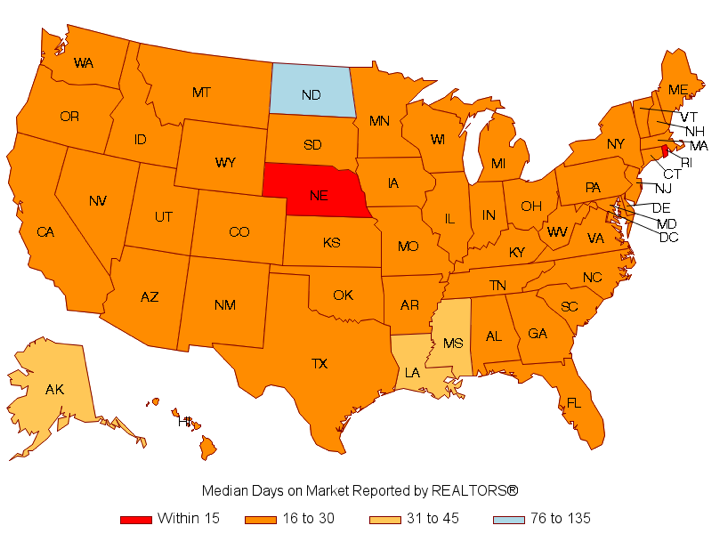
In almost all states, except for North Dakota, Alaska, Louisiana, and Mississippi, properties typically sold within one month. In Nebraska and Rhode Island, REALTORS® reported that properties typically sold in 15 days. Properties also sold quickly in states such as Idaho (17 days), Utah (18 days), Indiana (18 days), Tennessee (19 days), Washington (19 days), Massachusetts (19 days), Arizona (20 days), Colorado (20 days).

U.S. Map: Median Days on Market

Three Client Offers Per Property

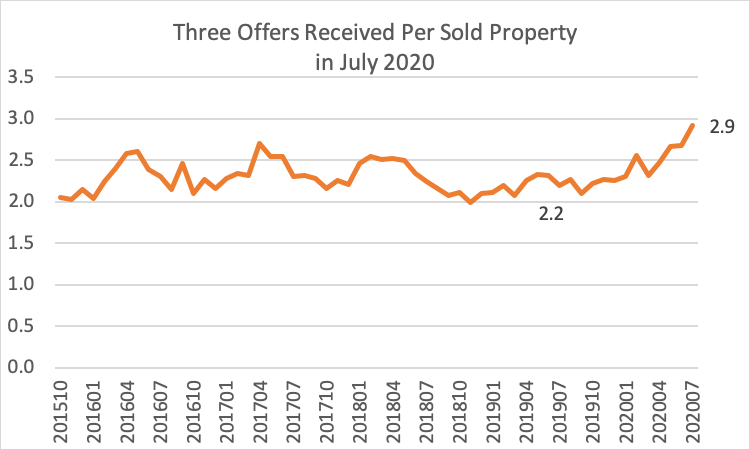
Not only are properties selling quickly, but they are also getting more offers. On average, REALTORS® reported nearly three offers per sold property in July 2020, up from about two offers one year ago.

Line graph: Number of Offers Received per Sold Property October 2015 through July 2020

Four Clients Taken on a Home Tour

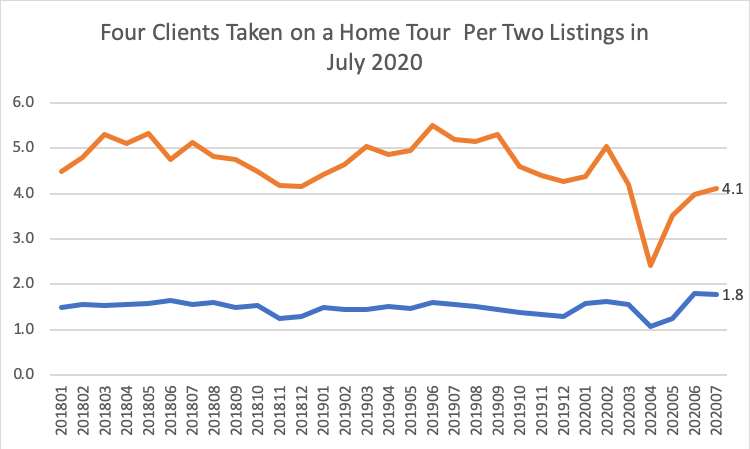
Demand has outpaced supply. On average, REALTORS® reported taking out four clients on a home tour, up from an average of two clients in February. Meanwhile, on average, REALTORS® reported listing only nearly two properties in July, although this is up from about one listing in April.

Line graph: Number of Clients Taken on a Home Tour per Listings January 2018 through July 2020

First-time Buyer Share Rose to 34%

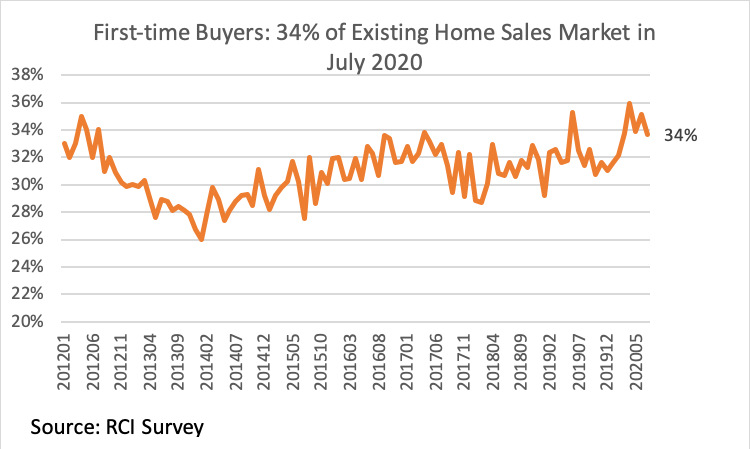
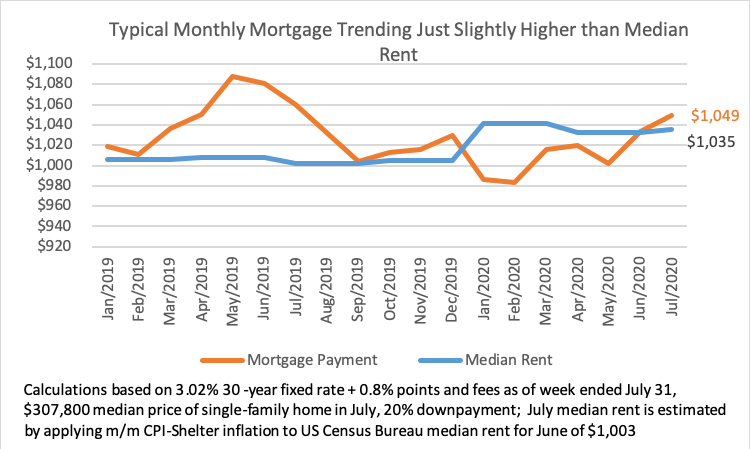
Who’s buying? In part, first-time homebuyers, which made up 34% of homebuyers in July 2020, up from 32% one year ago. Mortgage rates are at ultra-low levels, with the 30-year fixed rate averaging 3.02% in July 2020. The strong price appreciation has increased the monthly mortgage payment to $1,049 on a home purchased at the median sales price of $307,800 and financed with a 20% down payment loans, but this is just a little higher than the median rent of $1, 035. Concerns about safety and social distancing may also be increasing the demand for homes.

Line graph: First-Time Buyers Percent of Existing-Home Sales Market January 2012 through May 2020
Line graph: Typical Monthly Mortgage and Rent Costs January 2019 through July 2020

REALTORS® Buyer Traffic Index Shows Strong Demand

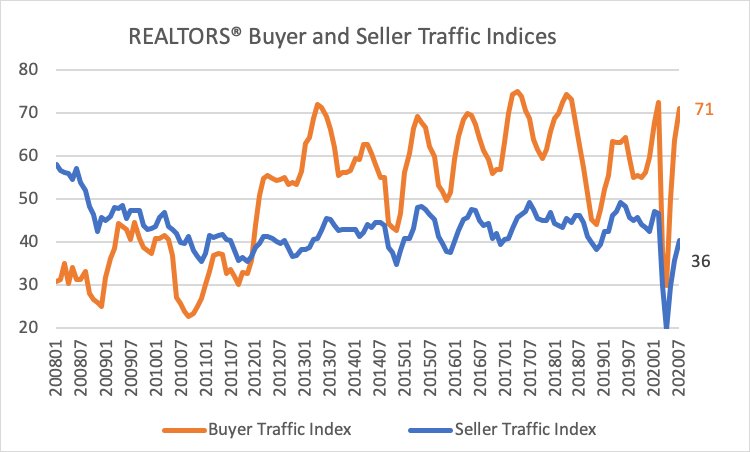
Compared to one year ago, about 4,000 REALTORS® reported that buyer traffic was broadly “strong.” The REALTORS® Buyer Traffic Index hit 71 in July, about the same level in February (72), after the index fell to below 50 in March and April.1 The housing market recovery has been relatively swift compared to the pace of recovery during the Great Recession when the Buyer Traffic Index stayed at below 50 from 2008 through 2011. Meanwhile, supply is broadly “weaker” compared to one year ago, with the REALTORS® Seller Traffic Index trending below 50.

Line graph: REALTORS® Buyer and Seller Traffic Indices January 2008 through July 2020

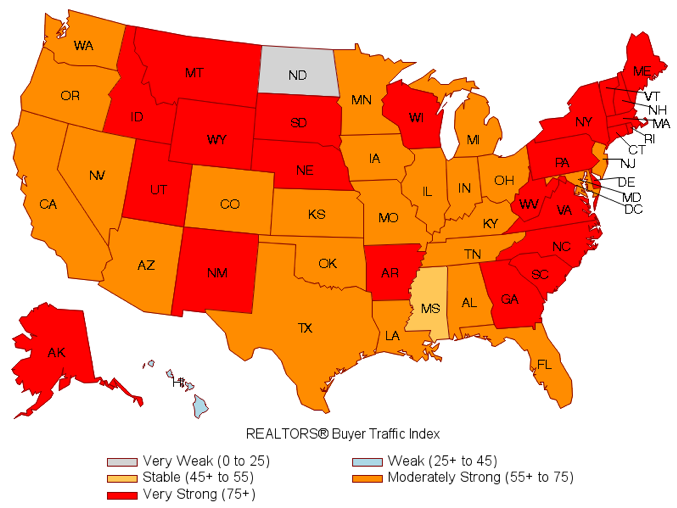
Respondents from all states reported that market conditions were broadly stable or strong, except in North Dakota which continues to be impacted by the drop in crude oil prices.

U.S. Map: REALTORS® Buyer Traffic Indices

1 The index measures homebuying activity in the reference month (July) compared to one year ago. An index above 50 more respondents reported that home searching activity rose compared to one year ago than the number of respondents who reported a decline.

Estafas sobre el coronavirus y cómo evitarlas

Mujer usando una laptop junto a artículos de protección contra el covid

Un estudio señala un aumento de estafas sobre el coronavirus a nivel nacional, siendo California el estado más afectado

De acuerdo a un estudio realizado por el sitio SocialCatfish.com que toca el tema de las estafas sobre el coronavirus por estado, los cinco estados principales son California (10,938 quejas, un aumento del 110% desde marzo), Florida (7,244 quejas, un aumento del 124%), Nueva York (6,677 quejas un 134%), Texas (6,427 quejas un 122%) y Pensilvania (4,245 quejas , hasta 201%).

A nivel nacional, la Comisión Federal de Comercio (FTC) ha registrado 144.727 informes de fraude que costaron a las víctimas $93 millones, una pérdida media de $263 por persona. Las compras en línea ocupan el primer lugar en la mayoría de las quejas a nivel nacional acumulando 22,124 informes.

4 estafas comunes de compras en línea que puede evitar durante la crisis del coronavirus:

1. La estafa de los precios inflados: Algunos minoristas están marcando artículos esenciales como papel higiénico y desinfectante para manos a niveles exorbitantes. Esto es particularmente atroz con un desempleo récord, ya que las personas simplemente no pueden pagar $30 por papel higiénico. La ley de aumento de precios varía según el estado, pero en promedio es ilegal marcar un producto hasta un 10% o más durante una emergencia declarada. Amazon ha tenido que eliminar medio millón de artículos para la venta en su sitio web debido al aumento de precios y ha suspendido 6,000 cuentas.

Cómo evitarlo: si sospecha que es víctima de un aumento de precios, repórtelo al Departamento de Justicia en www.justice.gov/coronavirus. Actualmente, el mercado está abastecido a precios normales para artículos esenciales y es una buena idea planificar con anticipación una segunda o tercera ola.

2. La estafa de productos no entregados: Hay miles de sitios web que ofrecen productos esenciales, como cubrebocas y guantes que simplemente toman su información financiera y de pago, pero nunca le envían el producto y además se quedan con su información para futuras estafas.

Cómo evitarlo: compre productos de grandes empresas en las que confíe. Si se trata de una empresa más pequeña, investigue buscando en Google para ver las reseñas y si se han presentado quejas.

3. Envíos con límite de tiempo: Debido a esta estafa, los vendedores están obligados por ley a darle una fecha de envío estimada o enviarle sus productos dentro de los 30 días. Hay una excepción para los clientes que abrieron una cuenta de tarjeta de crédito para comprar un producto, lo que les da a los vendedores un plazo de 50 días para enviar su producto. Si hay un retraso en la fecha de envío esperada, la compañía a la que le compró el producto debe notificárselo.

4. Estafa de comestibles gratis: Los estafadores envían mensajes de texto a sus víctimas diciéndoles que acaban de ganar comestibles gratuitos de Costco con un valor de $130. Todo lo que los clientes deben hacer es proporcionar a los estafadores su información personal, y supuestamente recibirán comestibles gratuitos de Costco en su puerta.

Cómo evitarlo: actualmente no hay una cadena nacional de comestibles que ofrezca alimentos gratis. No dé su información personal.

ORANGE COUNTY MARKET TRENDS 5/23/2020

Limited Inventory, Demand continues gaining momentum, Interest rates at a History Low, Plus incentives such as down-payment assistance programs for buyer are offering great opportunities to those looking to buy and sell! . . .
If you are paying more than $2,500 in rent, you can afford a mortgage. Send me a message and let’s have a conversation on how to take advantage of the opportunities now available…

by Marlon Gamez REALTOR®  |  Lic# 0‌2076704 (714) 650-0567 marlongamez@firstteam.com marlongamez.firstteam.com

What Home Buyers and Sellers Can Expect in 2020, as Pandemic Revises Forecast

Covid-19 written on a road, dark clouds, coronavirus epidemic crisis concept
Delpixart/Getty Images

There are so many ways in which 2020 is not turning out the way most Americans expected. In terms of real estate, we were hurtling toward a busy spring season. All the economic indicators looked strong, boosting buyers to battle it out for a limited supply of homes. But then the coronavirus pandemic swept across the nation, upending those expectations and forcing us to reassess the year ahead.

Home sales have fallen and real estate listings dissipated as the COVID-19 pandemic made many buyers and sellers think twice about buying, selling, and potentially even moving with a deadly and highly contagious virus on the loose. But home sales will rebound in the late summer and fall, driven by millennials eager to own a home of their own, according to a revised forecast for 2020 by realtor.com®’s economists.

Markets in smaller, more affordable cities and surrounding suburbs could be particularly brisk as folks reevaluate the appeal of big-city life during a pandemic. But realtor.com also predicts the housing market will experience a second round of pain in the form of another downturn toward the end of the year.

Related Articles

“COVID-19 has really dramatically changed the way the housing market is going to perform this year,” says realtor.com Chief Economist Danielle Hale. “We started off with the potential for the best year in more than a decade for sales. But we’re going to see ups and downs as the market grapples with an unsteady economy. This will affect buyers and sellers across the board.”

Sales of existing homes are expected to drop about 15% in 2020 compared with the previous year. Realtor.com is anticipating 4.5 million sales this year, compared with 5.34 million last year. The company’s economic team had originally forecast, late last year, that 5.25 million sales would take place in 2020.

While many cash-strapped buyers have eagerly anticipated prices falling, triggering a real estate bonanza similar to the Great Recession, that’s not likely to happen this time around. That’s because the number of homes on the market has fallen, by about 45% in April, and so has demand from buyers. There’s no glut of for-sale homes driving prices down.

“Sellers don’t like to reduce their prices. So they decide not to sell,” says Hale. Instead, they just pull their homes off the market.

The median price for an existing home is expected to hold steady, rising by just 1.1% in 2020 over the previous year.

“Were it not for COVID-19, we probably would’ve seen prices rise in the 2% to 4% range,” says Hale. That’s because even before the pandemic, available housing fell well short of demand, pushing prices up.

Buyers shouldn’t despair. Record-low mortgage interest rates will offset some of the slightly higher prices. Rates are expected to be around 3.2% this year, down from nearly 4% last year. And they could even fall into the 2% range later in 2020, amid further financial uncertainty.

The problem is, buyers may have a harder time snagging those low mortgage rates. Lenders are requiring higher credit scores and down payments, in some cases, as the nation grapples with unemployment rates that are likely in the 20%-plus range.

Another downside for buyers is that home construction is expected to slow, exacerbating the housing shortage. Housing starts, or the number of homes on which construction has begun, are expected to drop by 11% this year. Before the pandemic stalled construction sites in certain states, realtor.com had expected starts to jump by 10% in 2020.

Where buyers go shopping could also shift in the wake of the coronavirus. Those cooped up in small apartments in pricey cities may seek out smaller cities and suburbs where they can get more square footage and a backyard for less money. And with unemployment as bad as it’s been since the Great Depression, buyers may also seek out these areas for their lower prices.

“The experience of being at home for a long period of time has everyone rethinking their priorities,” says Hale. “People are recognizing space is more important, so they’re looking for more affordable areas where they can have more space at the same price.”